Many rooms, one control room
Interpreting and subtitles for trade fairs and congresses, open-plan stages included.
Nine parallel rooms at Fiere di Parma, six open-plan stages at BIT at Fiera Milano, twelve rooms at FORUM PA. Every room sends us its floor; in Milan it becomes interpreted audio and subtitles, and goes back to the audience on their phones and on the screens.
What makes a trade fair different
Lots of rooms at once
Parallel sessions across several rooms and halls, each with its own AV desk and its own AV company.
Rooms with no walls
Open-plan session areas a few metres apart, in the noise of a busy exhibition hall.
A programme that keeps changing
Sessions added and times moved right up to opening day. The service can't wait for the final programme.
An audience that keeps moving
Visitors coming and going between panels, with no common language.
How we work
- 1
All we need from the room is the floor
The original stage audio, from the AV desk that's already there: sent from a browser with Floor-In, or with whatever the AV company already uses. No computer per language to install.
Production & Service - 2
One control room, in Milan
At the RSI Hub the floor becomes speech and subtitles in the other languages. A linguist monitors the outputs and a technician sees every room at once: problems are spotted and fixed from Milan.
RSI Hub Milan - 3
An engine primed on the programme
With Context Training the engine learns speaker names, companies, technologies and acronyms before opening day. The published programme is often enough.
Context Training - 4
The audience listens and reads
A QR code opens the WebApp on people's phones: interpreted audio and subtitles on the same page. Subtitles also go up on screens and LED walls, from the Teleprompter page.
Converso WebApp
Open-plan stages: every audience hears its own room
In session areas with no walls, the problem isn't language, it's noise. With Assisted Listening, people in the seats hear their room's original audio, clean, in their headphones, from the same phone. With Floor-Through they choose their language once: they hear the original when the speaker uses their language, and the interpretation when the speaker switches.
It's an accessibility tool too: people who are hard of hearing can turn up the volume in their own headphones.
Recent trade fairs and congresses

Cibus Tec and Labotec 2026: nine rooms at a trade fair, one control room
Parma, Fiere di Parma · October 2026Read the case study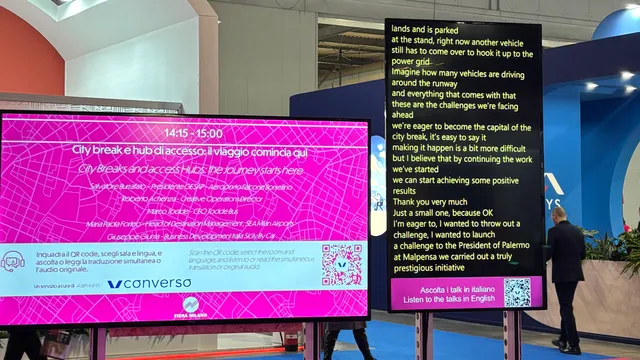
BIT 2026: RSAI Interpretation and Silent Meeting in Open Spaces
Rho Fiera Milano · February 2026Read the case study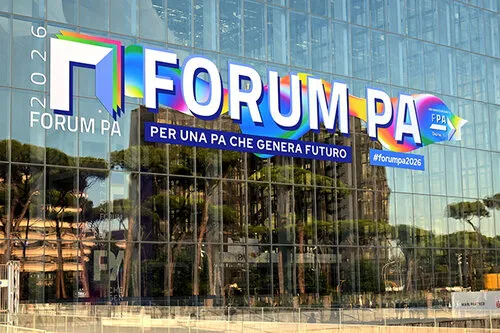
Twelve rooms captioned, from Milan. FORUM PA 2026
Rome, Roma Convention Center La Nuvola · June 2026Read the case study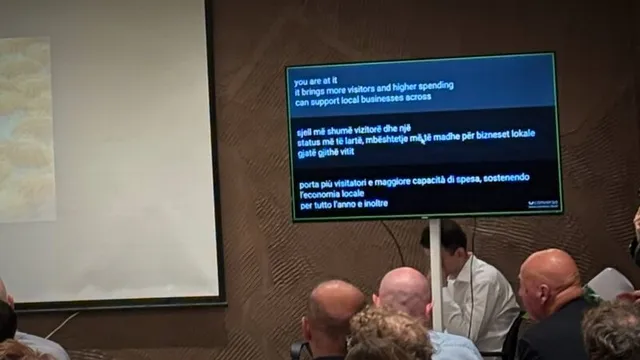
Balkans Sea Fair 2026 — Three languages on a single screen
Marina Orikum, Bay of Vlorë (Albania) · October 2026Read the case studyWhat we need from the venue
We talk to the venue's technical manager ourselves: you just put us in touch. The details are in the technical sheet we send about 21 days before.
- A stable, dedicated wired connection from the mixer to our capture point: Wi-Fi isn't enough for the floor.
- 10 Mbps upload for the floor, more if there are other streams: we check it in the technical test.
- A clean floor, with no walk-in music or announcements.
- Wi-Fi sized for the audience, if people listen in the room on the WebApp.
If the venue network has a strict firewall, we send IT the list of addresses and ports to open before the technical test.
How many rooms does your fair have?
Send us the programme, even a draft: we'll tell you how we'd cover it.
Get a quote