A two-kilometre control room. La Maria Brasca along the Navigli
La Maria Brasca lungo i Navigli is a promenade theatre production by Compagnia Teatrale Oltreunpo' APS, directed by Marco Oliva. It runs along roughly two kilometres of the Naviglio Grande canal in Milan, from San Cristoforo to the Darsena: the actors perform on land, at seven stations along the towpath; the audience follows them from the water, aboard six dragon boats in line. To hear the actors, every audience member needs audio in their headphones.
The Challenge
The first run, in March 2026, used an all-radio system: one transmitter and individual receivers for the audience. On a route like this, radio hit two limits.
Towards the audience. Six boats in line stretch so far that the last ones drifted out of the transmitter's range. The control desk had been moved onto the lead boat so the signal would start from the front of the line.
From the actors to the desk. The low-power headset radio mics had to reach the desk on board over a constantly changing distance, on a canal in peak season with dozens of bars and other radio systems running. That link did not hold.
For the 13 September 2026 performance, the setup could not depend on radio range over two kilometres of water.
The Solution
The guiding principle: take radio out of every long link, and handle up close the one link that has to stay radio — between the actor's headset and its receiver.
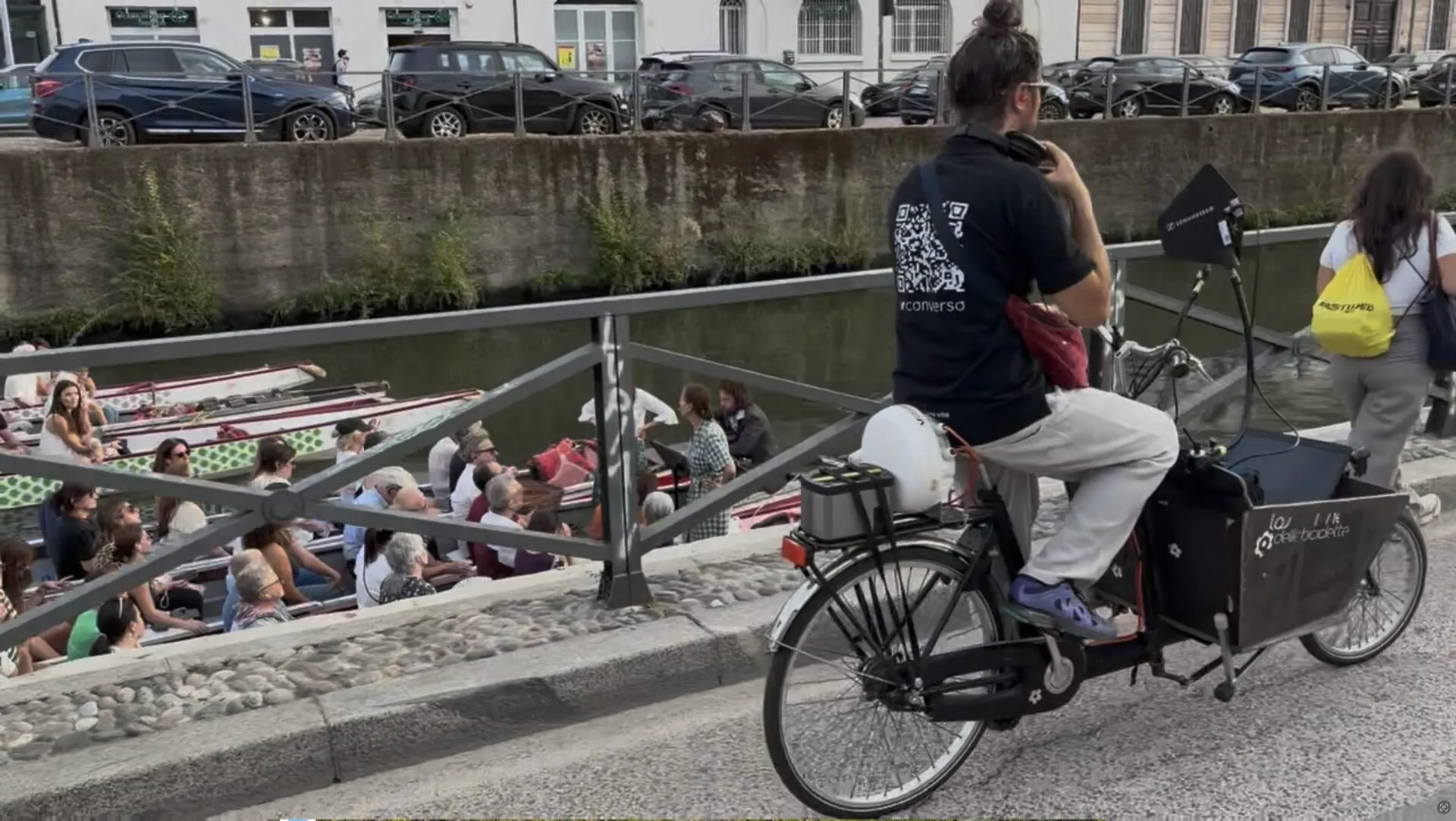
A sound desk on a cargo bike
The desk is no longer on a boat but on land, on a cargo bike that follows the actors along the towpath. On board: a PC, a mixer, four headset radio mics with their receivers and antennas, multi-SIM bonded mobile connectivity, and battery power with an inverter. The headset receivers travel a few metres from the transmitters, so the radio distance is kept to a minimum at every point on the route.
Film production sound gear for the one radio link
For the link that remained on radio we chose film location-sound equipment, the same kit used to record dialogue on set:
- Microphones: DPA 4488 headsets on Wisycom MTP 40S bodypack transmitters
- Reception: Wisycom MCR 42 receivers with the IKSS 42 antenna system
- Mixing and recording: Sound Devices 688 with a Sound Devices SL-6 receiver dock
- Power: Swit with NP1 batteries
The Sound Devices 688 is both mixer and recorder: as well as going up to the cloud, the actors' voices are recorded to card.
The musician's boat: where a cable reaches, use a cable
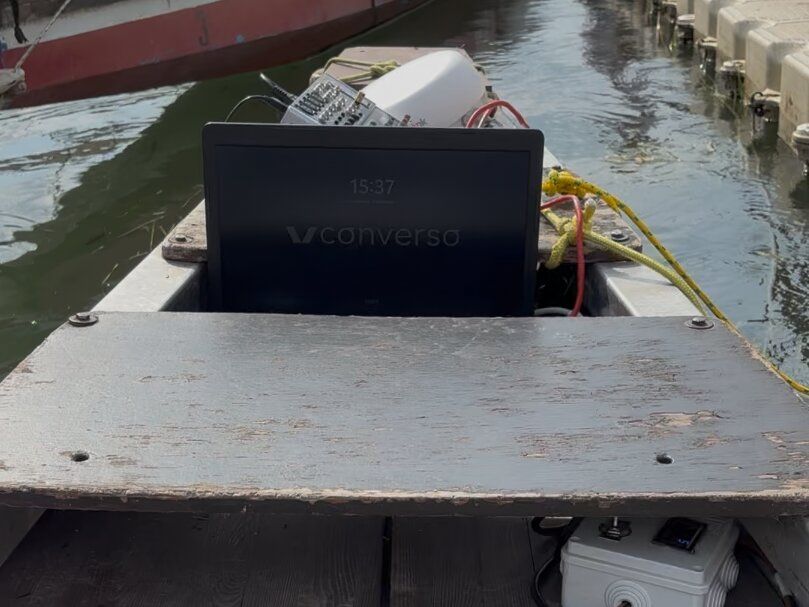
On the musician's boat, a second PC with bonded connectivity and two wired microphones: a Shure SM58 on a stand for vocals and a mic for acoustic guitar. No radio needed here, because the musician and the station are on the same boat, a metre apart. The boat does not send its audio to the bike: it sends it straight to the cloud, just as the bike does with the voices.
Two sources, one cloud matrix
The shore desk and the boat are two independent contributions, each with its own Audio-In interface. Converso®'s professional interfaces — Audio-In, Audio-Out, Soft Console — are built for remote production and work with a cloud audio matrix that receives multiple sources and combines them before distribution. Voices and music meet there, not over a cable or a radio link between boat and towpath: neither has to stay within range of the other.
Listening on their own phones
From the matrix, the programme feeds the Converso® Web App. Audience members scan a QR code and listen in their smartphone's browser, with their own headphones, without installing anything. Coverage depends on the mobile network, not on a transmitter's range: the length of the line of boats is no longer a constraint. For those without headphones, disposable earphones and minijack–USB-C/Lightning adapters were handed out at boarding.
Two people, no fixed position
This time, the production sound engineer pedals. For two hours the engineer follows the actors along the towpath from San Cristoforo to the Darsena, stops with them at each of the seven stations and sets off again when they do. In front, on the cargo bike: the 688 with the four headset channels, the antennas, the PC pushing the mix to the cloud. Behind, on the water: the line of boats following. The mix happens on the move, in plain sight — see the actor about to speak, open the channel, close it. Between stations: battery levels, SIM signal, stream stability.
The assistant works from the other side of the canal: at boarding they hand out earphones and adapters to anyone without headphones, help those who cannot scan the QR code, check that listening has started on every boat, and for the rest of the show keep an eye on the musician's station and the six boats. Neither has a fixed position: the control room for this show is two kilometres long.
The Results
No radio receivers were handed out to the audience: everyone listened on their own devices, across all six boats, for the full two kilometres. The audio chain was reduced to a single radio link, a few metres long and monitored in plain sight by the engineer moving with the actors.
The boat and the shore desk worked as two independent contributions to the cloud, with no direct link between them. And the whole performance was recorded on the Sound Devices 688.
The same approach works wherever the audience and the sound source are on the move: promenade and site-specific theatre, guided tours over long routes, events on the water, re-enactments and processions, tours of archaeological or industrial sites.
Technologies Used
Key Results
Expert Tip
When an event moves — along a canal, through a city, across an archaeological site — radio range becomes the bottleneck. Moving distribution onto the mobile network and keeping the sound desk physically close to whoever is speaking lets you cover routes of any length, provided there is adequate data connectivity along the way.
Want similar results for your event?
Contact us for a free consultation and discover how we can help you.