Why Palantir's CEO described Converso® without knowing it.
Alex Karp, CEO of Palantir — a company doing very serious things with artificial intelligence — recently stated that in the era of accelerated automation only two categories are structurally safe: those who work with their hands in physical reality, and those who think non-linearly.
The first — electricians, mechanics, plumbers — survive because their work depends on physical presence, case-by-case judgment, and the concrete messiness of the real world. The kind of things AI, however powerful, still cannot handle.
The second — non-linear thinkers — survive because they don't follow standard playbooks. They reframe problems, see patterns where others don't, operate outside predictable logic. They are, by definition, what an algorithm cannot replicate.
We read that analysis and looked at each other. Because Karp was describing Converso® — without having the slightest idea.
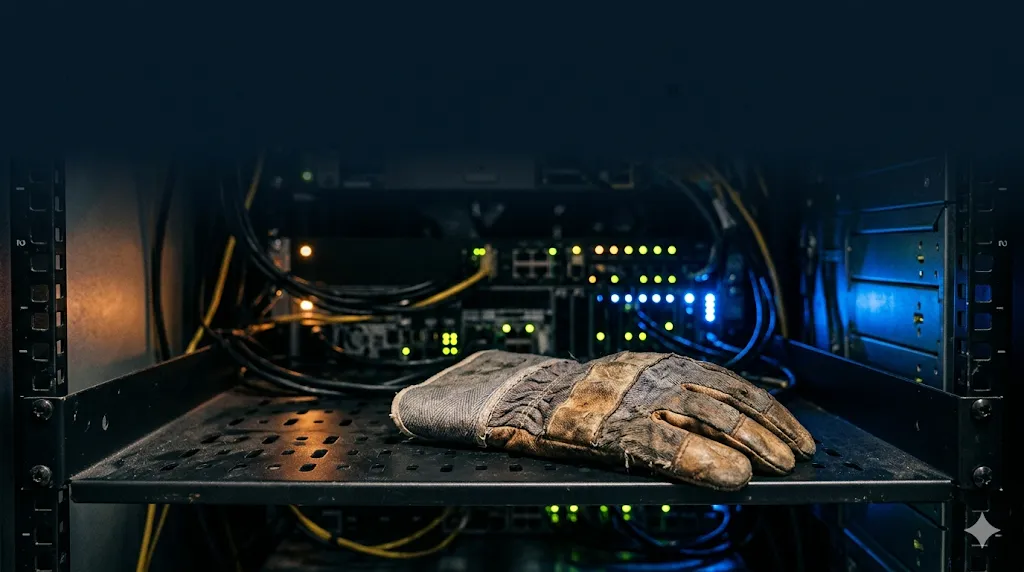
Hands in reality
Converso® was born in 2001 from a world of connectors, audio cables, radio frequencies and booths to be assembled. Not from a Silicon Valley garage, not from an incubator. From conference halls, trade shows, arenas — places where if the sound doesn't come through there's no commit to push, there's a 2,000-person event grinding to a halt.
Before writing a line of code, the team learned what n-1 is, how to set up ducking, why a headphone return makes the difference between an interpreter who works well and one who flounders. We embraced the IP revolution — Dante®, NDI® — as a liberation, not a fad. And when the interpretation world went all-in on cloud, Converso® built a physical RSI Hub in Milan: 14 soundproof booths, 3 control rooms, a 10 kW UPS, a backup generator. Iron. Concrete. Copper.
This isn't analog romanticism. It's why, when a modem drops during a 2,000-person event, there's a Converso® engineer with a flight case containing a compact RSI Bridge, 4G backup modems, multi-link bonding and a gimbal-stabilized camera. We did it in a factory in Finland, with 11 simultaneous languages among the machinery of an industrial plant. It worked. Not because the AI was better than the others, but because the person governing it had their hands in the real world.
Karp would say: hands-on workers. We say: system integrator.
Mind outside the box
Karp's second group — non-linear thinkers — is more interesting and more subtle. It's not about being creative in the decorative sense of the term. It's about seeing solutions where the market sees constraints.
In 2001, the market used infrared for simultaneous interpretation. It worked, but only in line of sight, with massive coverage limits. Converso® arrived with radio frequency: a single antenna covering entire arenas and squares. No one had done it because no one thought it was needed.
In 2004, everyone built interpreter booths out of heavy wood. Converso® invented the transparent polycarbonate booth — light, modern, transportable. The industry shrugged. Then it copied.
In 2014, when "BYOD" was still an acronym to be explained, Converso® brought simultaneous interpretation to smartphones. Zero receivers to distribute, zero logistics, zero plastic. The audience scans a QR code and listens. Today it's the standard. Back then it was heresy.
In 2017, among the first to do remote interpretation when the market still saw it as a shortcut. In 2019, when everyone was migrating to the cloud, Converso® built the only physical infrastructure dedicated to RSI in Italy. And in 2025, when the industry split between uncritical AI enthusiasts and nostalgic defenders of the human interpreter, Converso® wrote a manifesto that says: there are two tools for two different purposes. Choose with judgment, not with ideology.
Each step is a non-linear decision. It's not following the market. It's not contradicting it on principle either. It's looking at the problem from a different angle and building the solution that doesn't yet exist.
Why this matters for event organizers
Karp's analysis is not abstract sociology. It has an immediate practical implication for anyone choosing a technology partner for a multilingual event.
The market is filling up with pure-software platforms: elegant interfaces, convincing demos, infinite feature lists. Sixty languages included, real-time subtitles, setup in five minutes. All very linear. All very predictable. All very replicable — which means that, in a not-too-distant future, an algorithm will be able to do it just as well.
But a real event isn't a demo. A real event has a mixer that crackles, a speaker with an unexpected accent, a venue Wi-Fi that collapses at 10 a.m. when six hundred people connect at once, a CEO who changes the agenda at the last minute, and a debate that degenerates into vocal overlaps where the AI loses the thread.
In that moment, the difference is made by those who have their hands on the cables and their minds outside the box. Those who can switch from AI to human interpreter in real time without the audience noticing. Those who have a backup modem in the flight case. Those who know that ducking should be set one way for a plenary and another way for a panel. Those who have made mistakes, corrected them and done it again — in always different contexts, for twenty-five years.
This expertise can't be bought with a software license. It can't be replicated with a pitch deck. It can't be scaled with an investment round. It's the kind of competitive advantage Karp describes: structurally safe from automation, because rooted in physical reality and unconventional thinking.
The best AI is the one governed by those AI cannot replace
There's an irony Karp would probably appreciate: the companies best positioned to use artificial intelligence are precisely those that artificial intelligence will never be able to replace.
Those with hands-on experience know where AI works and where it doesn't, because they know the real terrain. Those who think non-linearly know how to integrate it in ways the market hasn't yet imagined. The two combined produce something a cloud-born company can never have: the ability to govern technology with the judgment of someone who lived in the world before the technology arrived.
Converso®'s RSAI manifesto is exactly this: we don't sell magic, we don't sell nostalgia. We sell the ability to decide — event by event, language by language, session by session — when the AI engine is the right choice and when you need a human interpreter with thirty years of diplomatic experience.
The next time you evaluate a vendor for your multilingual events, ask yourself: who's behind the software? Someone who only knows how to write code, or someone who also knows where to place the microphone, how to route an NDI signal, and why the floor audio always needs to be checked before the session?
Hands on the cables and mind outside the box. That's how you govern AI. Everything else is a demo.
Converso® is a registered trademark of ABB S.r.l. — System Integrator for multilingual events since 2001.To explore the RSAI manifesto: converso.cloud/rsai